
Why Your Shoulders Keep Creeping Up Toward Your Ears
· FlowState Seattle Massage
Tight shoulders creeping toward your ears? Learn why upper trap and levator tension builds, what a clinical massage session addresses, and when to see a doctor.
Book Now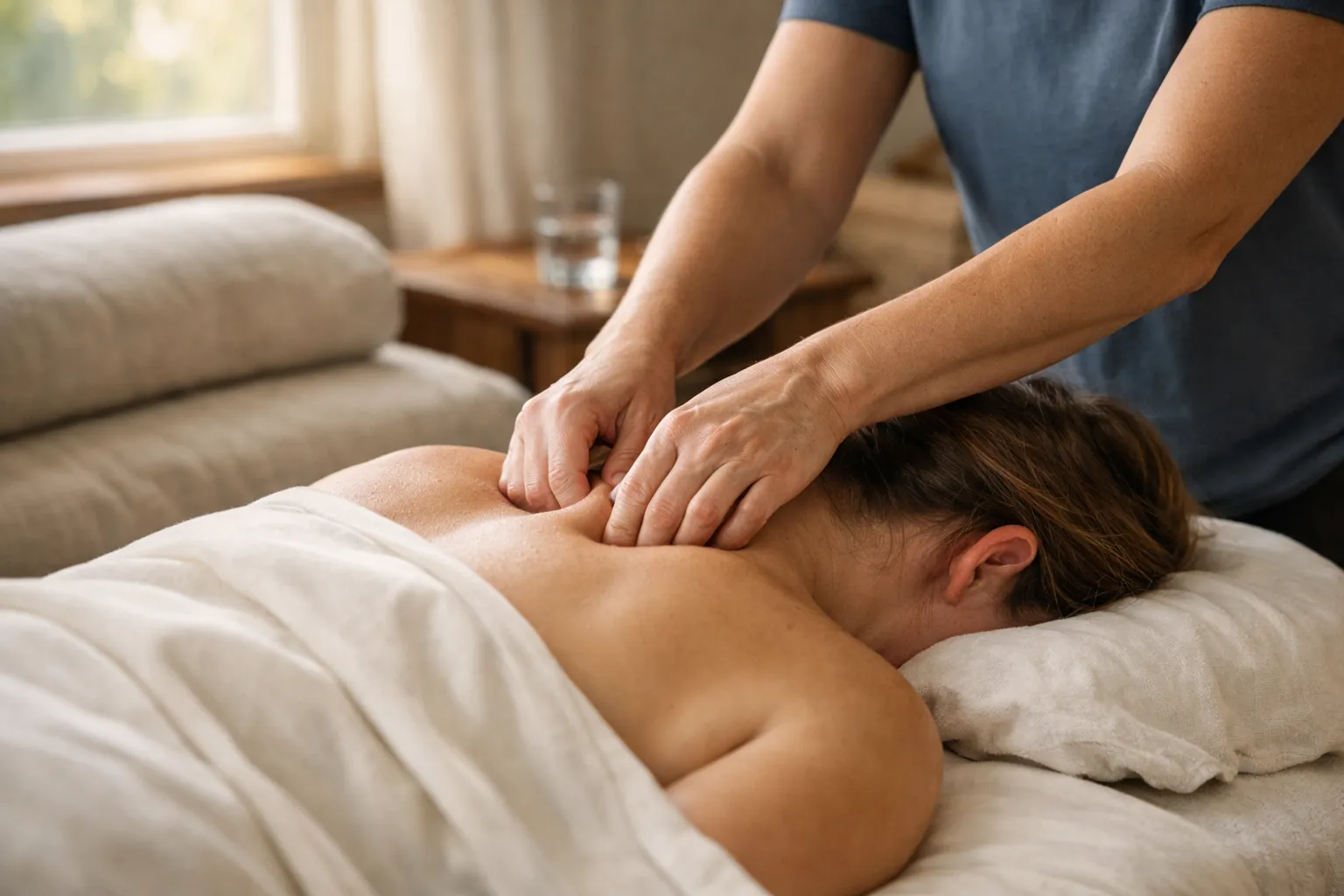
TL;DR: When your shoulders creep up toward your ears, the two muscles most responsible are the upper trapezius and the levator scapulae. Both respond well to clinical massage techniques including trigger point work, myofascial release, and contract-relax stretching. A session can reduce holding tension and improve range of motion, though the habits that reload these muscles every day need attention too.
You probably don't notice it happening in the moment. You're focused on a screen or gripping a steering wheel, and somewhere in the middle of all that your shoulders have climbed a full inch toward your ears without asking permission, hunching into the wind on Second Avenue is enough to do it on its own. By the time you notice, the ache is already there, sitting at the base of your neck like a knot you can't reach.
This is one of the most common patterns we see in a clinical setting, and it shows up across nearly every type of client: people who sit for eight hours, people who train hard, new parents carrying a baby on one hip, and people who have been managing low-grade stress for so long they've forgotten what it feels like to have their shoulders where they belong.
Understanding what's actually going on in the tissue makes the whole thing easier to address on the table, and easier to manage off it.
The Two Muscles Doing Most of the Work
Two muscles dominate this pattern, and they are worth knowing by name because they behave differently and respond to different techniques.
Upper trapezius. The trapezius is a large, diamond-shaped muscle that covers most of your upper back. Its upper fibers run from the base of your skull and the vertebrae of your neck down to the outer edge of your shoulder blade and collarbone. When those fibers contract, they lift the shoulder blade and rotate it upward. When they stay contracted, your shoulder stays up. The upper trap is also one of the most common locations for active trigger points: small, hyperirritable spots in the muscle tissue that refer pain into the neck and the side of the head, and sometimes behind the eye as well.
Levator scapulae. This one is less famous but often more stubborn. It runs from the top four cervical vertebrae down to the upper inner corner of your shoulder blade. Its job is to lift the scapula and help rotate it downward. When it's chronically tight, turning your head to one side feels like pulling against a cable, and that deep ache between your neck and shoulder blade that you can almost but never quite reach? That's often the levator.
These two muscles work together in the same holding pattern, which is why treating one without addressing the other tends to bring only partial relief.
Why the Pattern Keeps Reloading
Muscles don't just get tight for no reason. The upper trap and levator tighten in response to load and posture, and they tighten further when the nervous system registers a threat, and in most people, all of these factors are running at once.
Common drivers include:
- A monitor positioned too low or too far to one side, which keeps the head tilted or rotated for hours
- Prolonged sitting with the arms unsupported, which puts a constant low-level pull on the shoulder girdle
- Carrying a bag on one shoulder, which loads the levator asymmetrically
- Stress and anxiety, which genuinely do cause the shoulders to rise as part of the body's protective bracing response
- Overhead training without enough lower-trap and serratus activation to balance the load
The reason this pattern is so persistent is that the nervous system learns it. After enough repetition, the resting tone in these muscles rises, meaning they hold more tension even when you're not actively doing anything that should require it. That elevated resting tone is what keeps the shoulders up and what makes the ache come back a few days after a good stretch session.
What a Clinical Massage Session Addresses
A well-structured session for this pattern typically involves more than one approach, because the tissue presentation is usually layered.
Trigger point therapy is often the first order of business. A therapist can locate the active points in the upper trap and levator, apply sustained pressure to reduce their irritability, and then work the surrounding tissue once those points are quieter. Many clients find this produces an almost immediate shift in perceived tension, though it can feel tender during the work itself.
Myofascial release follows the trigger point work in many sessions. The fascia wrapping the upper trap and the cervical muscles can become restricted over time, and slow, sustained pressure through that tissue tends to let it release in a way that faster strokes don't. If you've read about how myofascial release differs from deep tissue work, you'll recognize this as the technique where the therapist seems to barely be doing anything, right up until the tissue suddenly softens under their hands.
Contract-relax stretching is particularly useful for the levator. The therapist brings your neck into a position that gently loads the muscle, asks you to resist for a few seconds, then guides the stretch further as the muscle relaxes into the new range. This technique works with the nervous system rather than fighting it, and many clients find they get significantly more range of motion from it than from passive stretching alone.
Deep tissue work through the upper back and the base of the neck rounds out most sessions, addressing the compensating muscles (rhomboids, middle trap, cervical extensors) that have been working harder because the upper trap has been doing what it shouldn't.
What Massage Does Not Do for This Pattern
This is worth saying plainly. A single session can reduce holding tension and improve range of motion, while also giving the nervous system a chance to reset. What it cannot do is permanently change the posture habits or workstation setup that reload the same muscles every day.
If you go back to the same chair and the same screen height the next morning, carrying the same stress levels, the pattern will rebuild. That is not a failure of the work. It is just how tissue responds to repeated input. Many clients find that regular sessions help them stay ahead of the cycle, and the gap between sessions often widens as the tissue becomes easier to reset.
It is also worth knowing that not every neck and shoulder ache originates in these muscles. Cervical disc issues and nerve root compression can both produce symptoms that overlap with upper trap and levator tension, and so can thoracic outlet syndrome. If your symptoms include numbness or tingling down your arm or weakness in your hand, particularly pain that is sharp and shooting rather than achy and diffuse, see your physician before booking a massage. A therapist can work alongside other care, but those presentations deserve a clinical evaluation first.
For runners and endurance athletes, upper trap tension sometimes pairs with the kind of forward-head posture and thoracic rounding that shows up after high mileage weeks. The same muscles are involved, but the loading pattern is different. Sessions that address neck and shoulder tension alongside broader postural work often make more sense than treating the shoulders in isolation.
Self-Care Between Sessions
A few things consistently help clients maintain what the work achieved:
- Raise your monitor so the top of the screen is at or just below eye level
- Set a reminder to check your shoulder position once an hour and consciously let them drop
- Doorway chest stretches take pressure off the front of the shoulder and reduce the forward pull that keeps the upper trap activated
- Chin tucks (gently drawing the chin straight back, not down) help restore the cervical curve and reduce the constant isometric demand on the levator
- Strengthening the lower trapezius and serratus anterior gives the upper trap someone else to share the load with
None of these replaces hands-on work for tissue that is already guarding, but they slow down how quickly the pattern comes back.
Frequently Asked Questions
What is the difference between upper trap tension and levator scapulae tightness? They are neighboring muscles that often get tight together, but they have different attachment points and slightly different jobs. The upper trapezius lifts and stabilizes the whole shoulder girdle and is the more common location for referred-pain trigger points. The levator scapulae attaches higher on the neck and tends to restrict head rotation more than the trap does. A therapist will usually address both in the same session because the holding pattern involves both.
How many sessions does it take to see improvement? There is no honest answer to a specific number because it depends on how long the pattern has been there and what keeps reloading it, and your tissue's response adds another variable entirely. Many clients notice a meaningful shift in a single session. Longer-standing patterns usually benefit from a short series of sessions spaced closer together at first. Your therapist can give you a more specific read after the first session.
Can tight upper traps cause headaches? Yes, this is a well-documented referral pattern. Active trigger points in the upper trapezius commonly refer pain up the side of the neck and behind the ear, often extending into the temple. If your headaches sit on one side and tend to worsen when your neck and shoulder tension is at its worst, upper trap trigger points are a reasonable place to look. For a fuller picture of how cervicogenic headaches develop, see the migraine and tension headache post, which covers that referral pattern in more detail.
When should I see a doctor before getting massage for neck and shoulder pain? See your physician first if you have numbness or tingling in your arm or hand, or any weakness there. Pain that feels sharp and shooting, electric rather than achy, also warrants a medical visit before massage. A recent neck injury or whiplash. Or pain that gets noticeably worse with movement in a specific direction. These can point to nerve or disc involvement that needs a diagnosis before hands-on work begins. Massage can often be part of the recovery plan after that evaluation, but it should not be the first step.